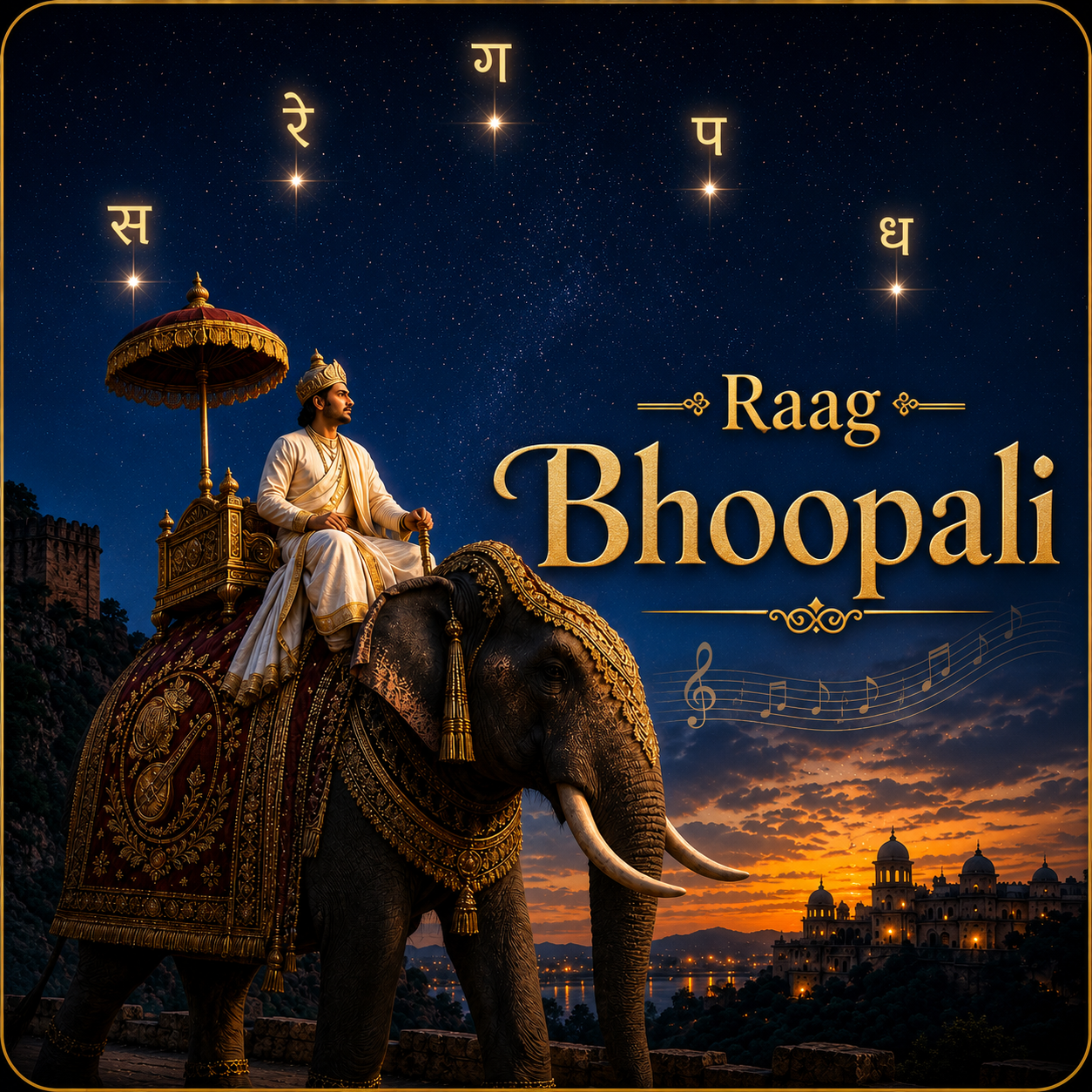
Raag Bhoopali
King Bhoopali: The Royal Sage of Peace and devotion
There was once a monarch known in every land for his majestic presence—King Bhoopali. He walked with the grace of an elephant and spoke with the clarity of a conch-shell’s call. His court marveled at the precision of his decisions, the straightness of his rule, and the regal rhythm of his life.
The Regal Movement – The Aroh (Ascent)
Whenever he entered his hall, his gait itself seemed to follow the upward steps of the aroh (Sa–Re–Ga–Pa–Dha–Sa).
Upright, luminous, never faltering.
Like ascending steps, his movements carried a natural authority. There was no pomp or unnecessary flourish—his majesty was in his very simplicity. Courtiers whispered: “The King does not just rule, he elevates us—step by step—like a melody rising.”
Inner Devotion – The Avaroh (Descent)
Yet, beneath this royal composure lived a heart bathed in devotion and peace. In the evenings, as twilight spread its saffron glow, the King would withdraw from the grandeur of his court. Sitting before a small lamp, he would close his eyes and return inward, descending gently like the avaroh (Sa–Dha–Pa–Ga–Re–Sa). There, no longer a monarch, he was a humble devotee.
His inward descent was gentle and compassionate—a poignant reminder that true greatness is marked by humility.
He had no attachment to Ma Ni (Pun) Money. That’s why he is called the Royal Sage.
The Grandeur of King Bhoopali
In the court of King Bhoopali, every movement was music. His entry into the royal hall was not loud, nor ostentatious—it was as graceful and inevitable as a raga unfolding.
Ga Re Pa Ga – The Royal Gesture
When he raised his hand to address his court, the motion was like the phrase Ga Re Pa Ga:
Ga to Re — a gentle bow downward, his gaze meeting that of his people with humility.
Re to Pa — a sudden upward lift, a command that reached high with authority.
Pa returning to Ga — the graceful return, never abandoning simplicity despite grandeur.
This gave his presence both strength and elegance. Just as the phrase arches outward yet curls back inward, so did his actions—majestic yet always rooted in humility.
Sa Re Pa Ga – The Arc of His Demeanor
When he walked among his ministers or spoke to the common folk, it was the flow of Sa Re Pa Ga:
Sa to Re — beginning in grounded simplicity.
Re to Pa — rising with stately dignity, royal in command.
Pa to Ga — returning again, soft with compassion and accessibility.
Thus, his grandeur, though majestic, was not cold but a living arc of dignity and devotion. He embodied ascent and return in the same breath, like Bhupali’s signature itself.
Grandeur With Inner Peace
Courtiers said, “Our King’s gestures are music itself. His authority is majestic like a rising phrase, but his heart bends back toward us like the soft return of notes.”
In the hall, when he stood, he was kingly power, firm and radiant. But when he sat in the temple at dusk, his devotion echoed through the court just as Bhupali resonates most deeply in the quiet of early night.
So, the pakad phrase Ga Re Pa Ga, Sa Re Pa Ga became his royal emblem—a pattern of grandeur balanced with humility, majesty folded into simplicity. King Bhupali’s movements were not just human—they were the very gestures of the raag breathing through him.
The Twin Nature of Bhoopali
Thus, King Bhoopali embodied both:
The Majestic Outer Form: noble, radiant, commanding respect.
The Peaceful Inner Flame: devotional, tranquil, soothing to all who came near.
Like Raag Bhoopali itself, he carried within him the nobility of a king and the silence of a sage. His personality was both royal and saintly, a balance of outer power and inner peace.
The Time and Aura
When the lamps of evening were lit in his palace, the people felt a strange peace seep into their own hearts. For they knew that their king was not merely guarding the body of his kingdom—but praying for the soul of his people. His reign became both a shield and a blessing.
And so, musicians say: whenever Raag Bhoopali is sung in the early night, it is the remembrance of that kingly sage—majestic in movement, yet constantly bending toward peace, devotion, and eternal simplicity.